When designing a wireless network, a common decision is whether to deploy access points (APs) with 2×2 or 4×4 antenna configurations. This choice affects not only wireless coverage and performance, but also total cost of ownership (TCO), cabling, and long-term scalability. In this blog, we break down real-world data to highlight the trade-offs between 2×2 and 4×4 APs, and when each makes the most sense.
The Theory: Its just math right?
This below picture illustrate that due to antenna combining, a 4×4 AP can output 3 dB more effective power then a 2×2. effectively doubling the signal strength over a 2×2 in many cases. And thats because your MIMO gain, Most infrastructure wireless systems will compensate for the power on the 2×2 by increasing the power.
Now in practice:
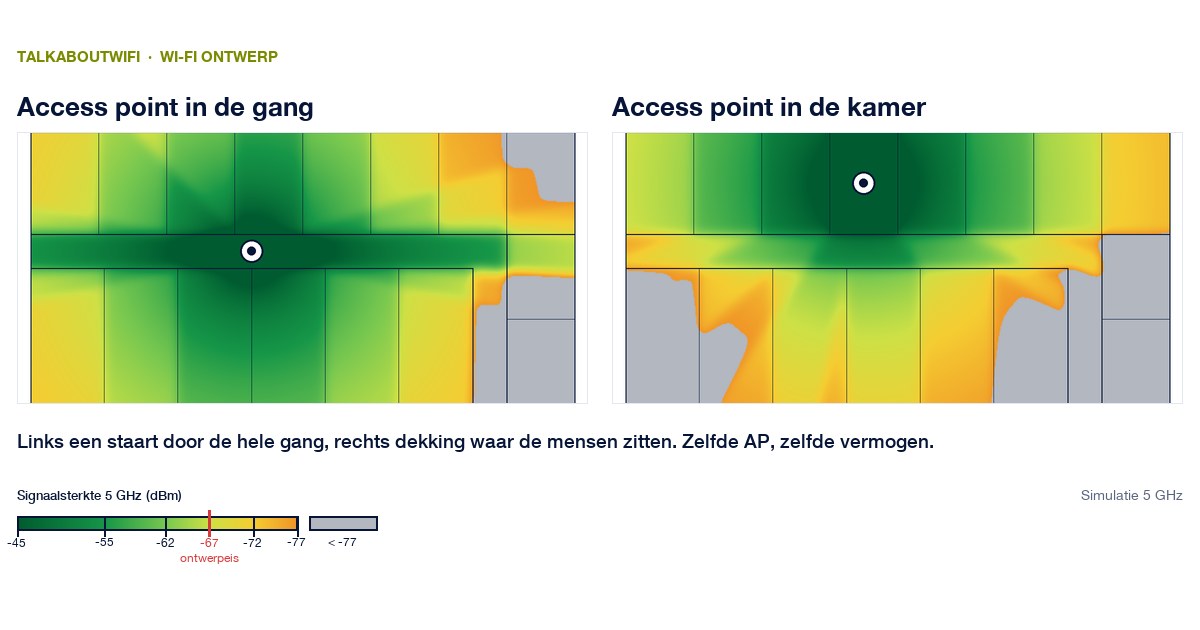
Below is a diagram with on the left a 4×4 AP and on the right a 2×2 AP (its the same AP).
We see a 5dBm difference and, this is just the real world example it will go close the 3dBm in theory but always effected by the environment

Note that if you don’t have multi-path in your environment, using the spatial streams to boost the dBm is less effective.
Retries vs RSSI: 4×4 holds up better at low signal strength
When we look a retries versus RSSI strenght between a 2×2 and 4×4 AP we see how the transmission retry rates spike for 2×2 APs below -85 dBm, while 4×4 APs maintain stability even at weaker signal levels. This is due to better spatial diversity and multipath utilization from more antennas.
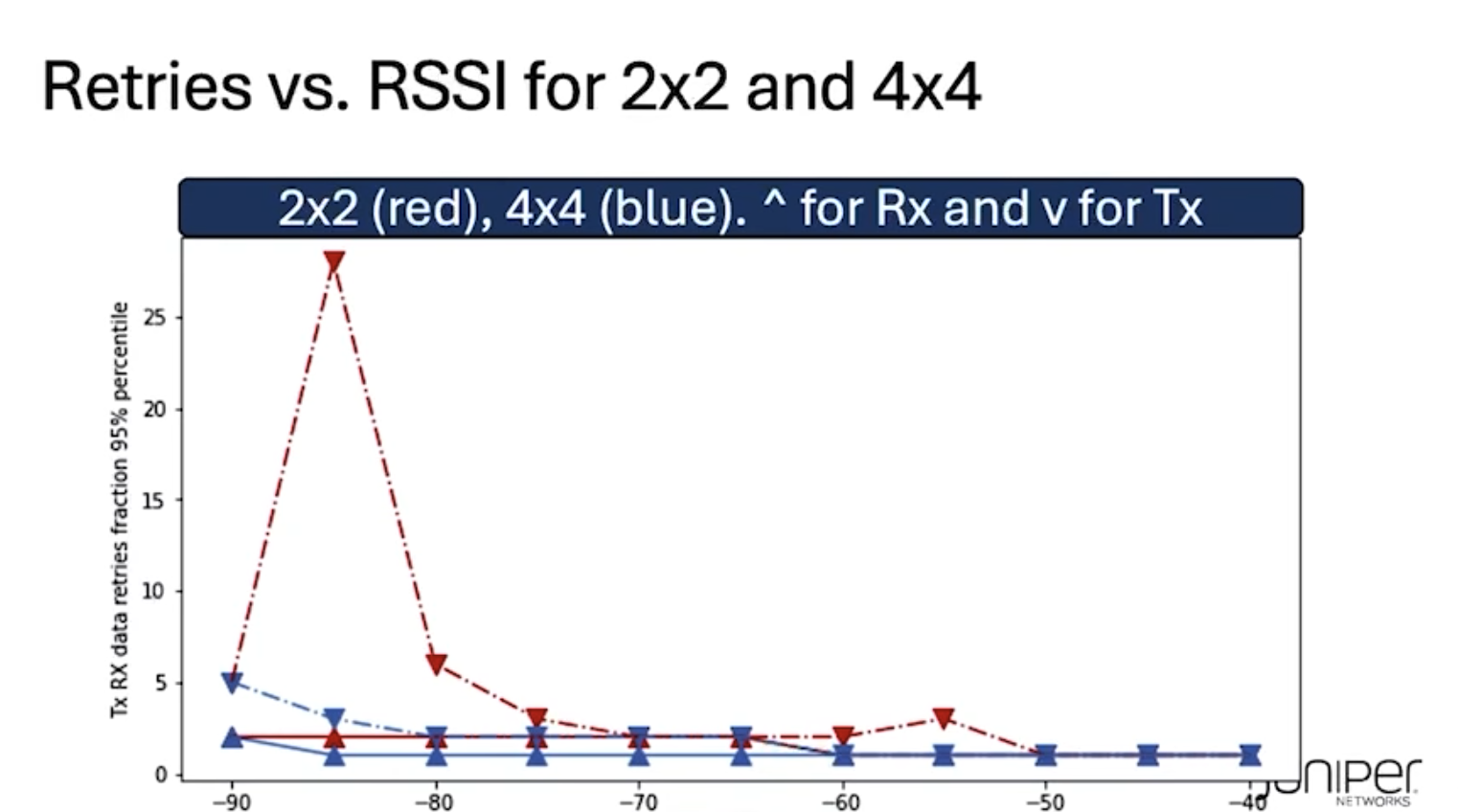
- Red = 2×2
- Blue = 4×4
Receive Data Rates: Higher Throughput with 4×4
The side-by-side plots show receive (Rx) throughput vs client RSSI from to different vendors

At equal RSSI values, 4×4 clients consistently achieve higher data rates. This means shorter airtime use per transmission, freeing up bandwidth for others.
Transmit Data Rates: 4×4 still wins
Similarly, on the transmit (Tx) side:
- 2×2 APs show drop-off in performance below -65 dBm
- 4×4 APs retain higher throughput further into lower RSSI zones
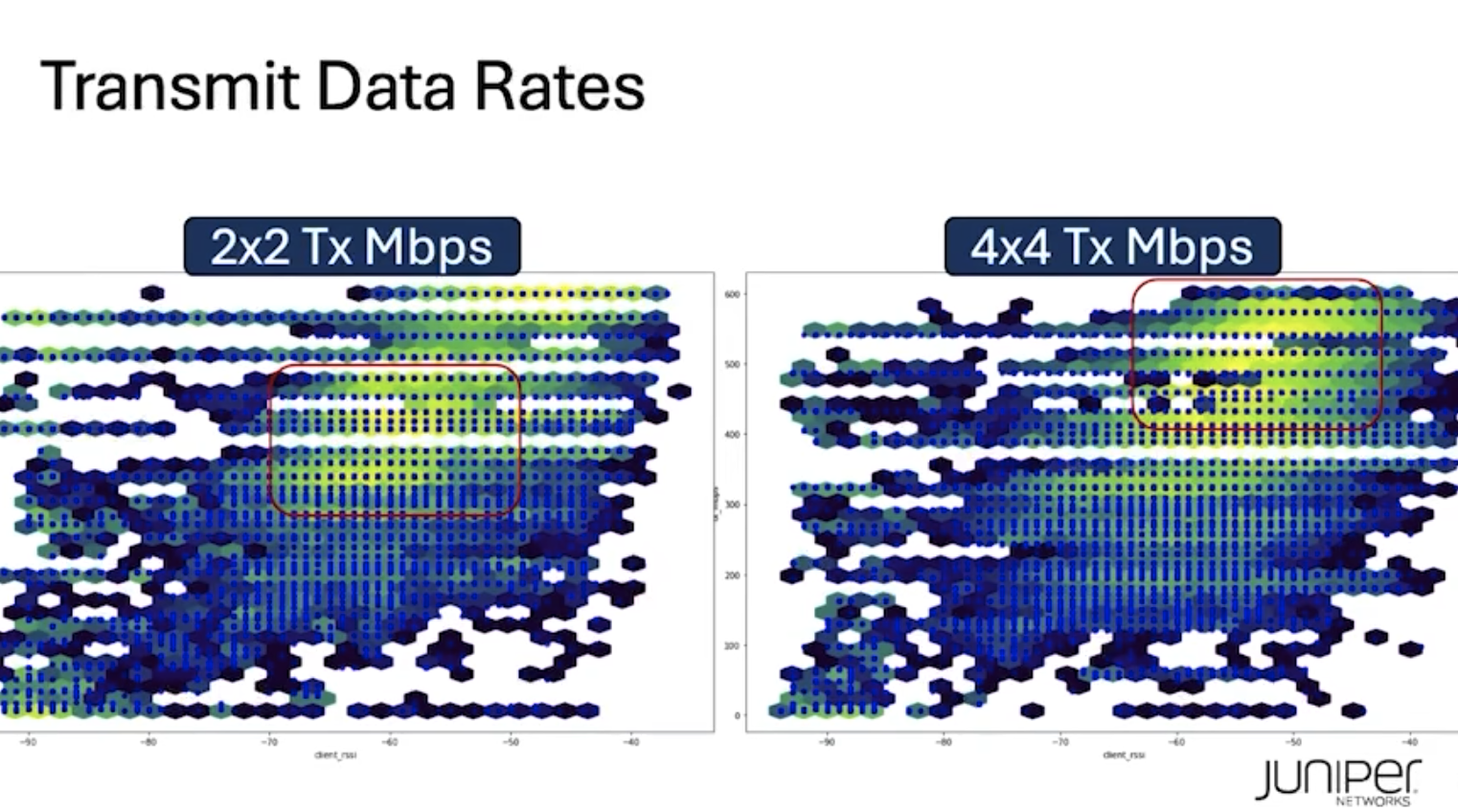
Its about a 100 – 150Mbps difference on both Tx and Rx and a 4-6dBm difference how good the AP can hear the client because of MCS. The question is does it matter… in theory it does in real world it depends…
Multi-Client Throughput: Scaling Matters
Below chart is a test from juniper mist that compares performance from two vendors under increasing client load:
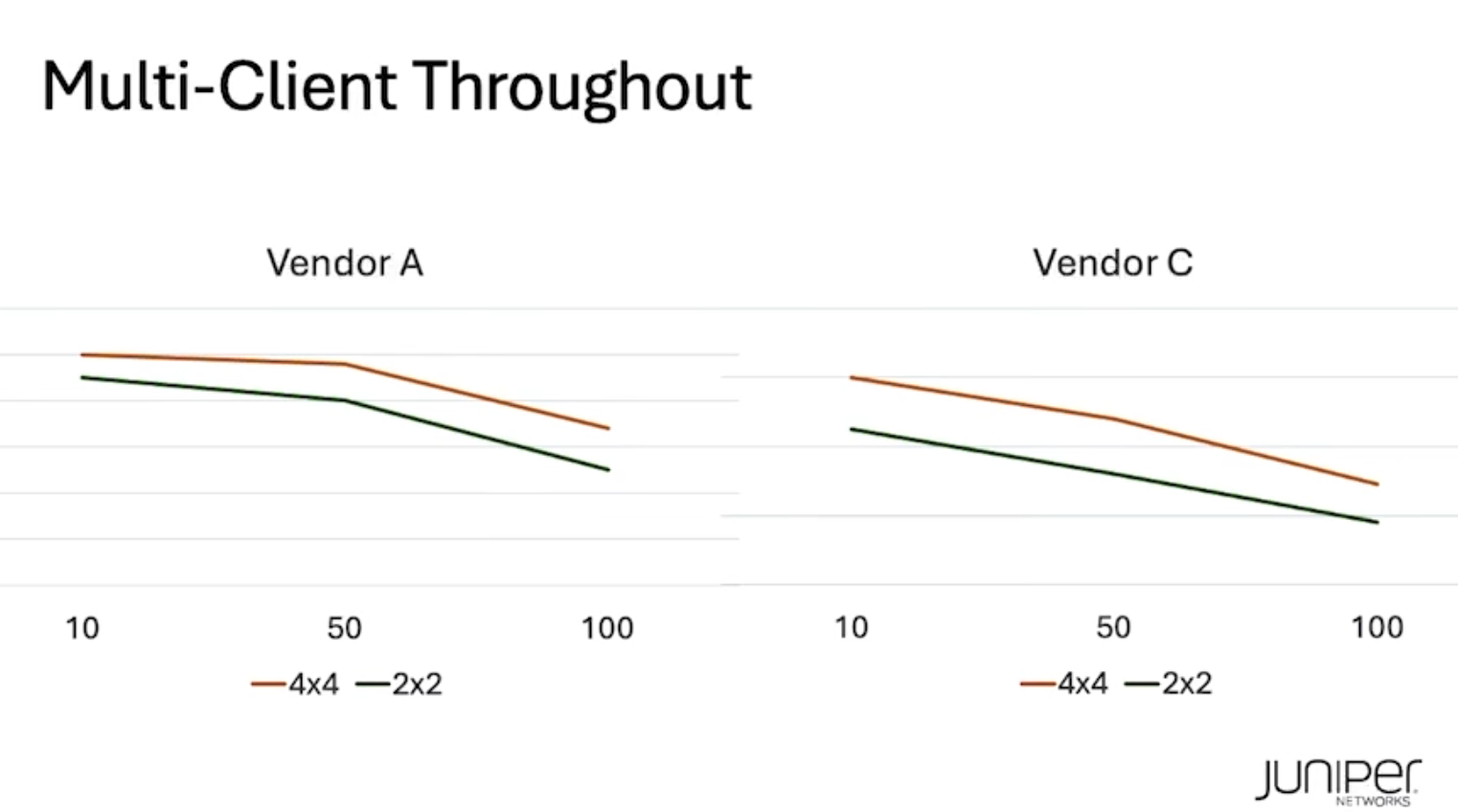
- In both cases, 4×4 APs outperform 2×2, especially with 40-50 or more clients the effect is bigger.
- This advantage becomes more important in high-density environments
Total Cost of Ownership (TCO): Not Just Hardware
Pros of 4×4:
- Fewer APs needed: One 4×4 can cover more area and users, reducing hardware count
- Less cabling: Lower installation effort, PoE switch ports, and physical cabling
- Improved stability at lower RSSI zones
Caveats:
- Higher unit cost for 4×4 APs
- More power draw, requiring higher PoE budgets
- One big AP = one contention domain: A 4×4 AP with 80 clients can create performance bottlenecks
- The AP hears the client longer which can result in sticky clients when placing to dense.
In some scenarios, splitting load over multiple 2×2 APs is better to reduce airtime contention and distribute clients more evenly.
Recommendation Matrix
| Environment | Recommended AP Type | Rationale |
|---|---|---|
| Open office space | 4×4 | Higher coverage and fewer APs needed |
| Classroom or auditorium | 4×4 | High client density requires better spatial capacity |
| Industrial / warehouse | 4×4 | Better resilience at long range and poor RSSI |
| Small business office | 2×2 | Lower cost, sufficient performance for typical usage |
Final Thoughts
4×4 access points offer strong technical benefits, especially in coverage and performance at scale. However, bigger isn’t always better. Network design is about balance: the right radio, in the right place, with the right load. Make data-driven choices to optimize user experience and long-term ROI.
Ready for smarter WiFi design?
At MetaWiFi, we build wireless networks that don’t just look good on paper, they perform in the real world. Whether you’re considering 2×2 or 4×4 access points, we help you make the right choices for optimal coverage, capacity, and cost-efficiency.
Get in touch for a free consultation or a quick network assessment.
metawifi.com – Because everybody needs great WiFi

Andy Stevens, CWNE #486 en oprichter van MetaWiFi. Ontwerpt, meet en valideert Wi-Fi netwerken voor bedrijfskritische omgevingen en schrijft daarover op TalkAboutWiFi. Meer over MetaWiFi